

Bathroom Remodeling
Built to stay dry, and specified so the water you save is also hot water you never paid to heat. Waterproofing you can see photographed before it is covered.
Learn more
A kitchen is the hardest room in the house to remodel because it is not one trade, it is six, and every one of them has to arrive in the right order. It is also the only moment when the walls, the circuits and the appliances are all open at once, which makes it the cheapest opportunity you will ever get to make the room efficient. Adding a dedicated 240-volt circuit for an induction range during a remodel costs very little. Adding it two years later means opening a finished wall.
Take the efficiency decisions while the walls are open, because every one of them gets expensive the day the drywall goes back on.
Induction is up to three times more efficient than gas at getting heat into the pan, and around 10% better than a smooth-top electric range.
Gas cooking is also an indoor air quality issue. Stanford research published in 2024 found that typical gas and propane stove use adds around 4 ppb to annual household nitrogen dioxide exposure, with homes under 800 square feet seeing roughly twice the national average exposure.
LED lighting uses at least 75% less energy and lasts up to 25 times longer than incandescent, and a kitchen is usually the most heavily lit room in the house.
Refrigeration is 25% of a California home's electricity, more than air conditioning, and it runs every hour of the year. If your kitchen budget is tight, an efficient refrigerator does more for your bill than almost anything else in the room, and it is the appliance people most often carry over from the old kitchen without thinking about it.
Works best with: Electrical Plumbing Flooring
Savings depend on your house, your equipment and how you use it. We will not quote you a guaranteed number, and neither should anyone else. See the rebates currently available
Layout and space planning, demolition, framing or wall changes, relocated plumbing and gas, new dedicated circuits and lighting, cabinetry, countertops, tile, appliance installation and finish work. We build the schedule backwards from the countertop template, because the fabricator cannot measure until the boxes are set and level, and that single date governs everything before and after it. You get that schedule in writing before demolition starts.
A 240-volt circuit ready for induction whether or not you switch today. LED under-cabinet and recessed lighting on dimmers. A properly ducted range hood vented outside rather than recirculating, which matters a great deal if you keep gas. Insulation and air sealing in any exterior wall that gets opened. A WaterSense faucet. If the water heater serves the kitchen and is near end of life, this is the moment to deal with it while access is easy.
Anything involving new circuits, moved plumbing or removed walls is permitted work in the City and County of Los Angeles. We pull the permit, schedule the inspections and keep the card on site. We also plan the parts you feel day to day, a temporary sink and refrigerator where the space allows, dust walls at the openings, and a realistic date rather than an optimistic one.
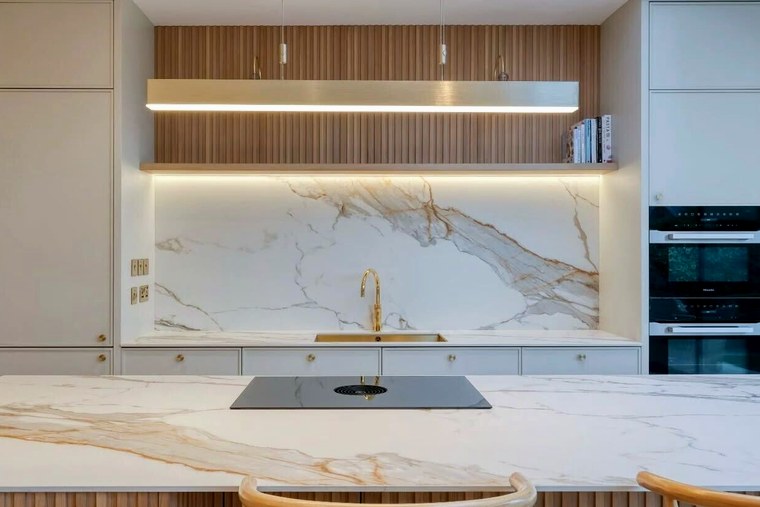
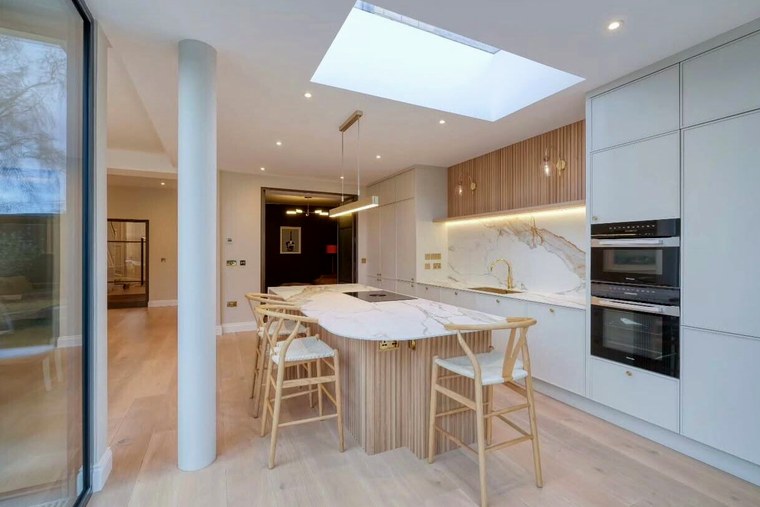
A cosmetic refresh that keeps the existing layout is typically three to four weeks. A full gut with relocated plumbing and electrical runs six to ten weeks, and roughly two of those are the countertop fabrication window after templating.
If you are opening the walls anyway, at minimum run the circuit. Induction is faster, far more efficient than gas, and removes a combustion source from the room. If you love cooking on gas, keep it, but let us duct the hood outside properly.
Almost always. We set dust barriers at the openings, protect the flooring on the path in and out, and where there is room we set up a temporary sink and refrigerator so the house still functions.
Built to stay dry, and specified so the water you save is also hot water you never paid to heat. Waterproofing you can see photographed before it is covered.
Learn moreStraight answer: flooring is not an energy upgrade. What it can do is close the gaps, insulate over a crawlspace, and hold cool underfoot.
Learn moreCooling is the biggest electricity line in most inland LA homes. A right-sized high-efficiency system cuts it, and we size it to the house rather than to the old label.
Learn more